Bernini’s Apollo and Daphne[i], perhaps the paradigm of Baroque sculpture, depicts the moment when the fingertips of Apollo first brush the skin of the woodland nymph. Simultaneously, Daphne’s own fingers burst into bloom: she is transformed into a tree, to escape the insult Apollo is determined to inflict.
Cate Consandine somehow places us moments before this impact. A thick musk of desire permeates the space of the gallery, pheromones linking the works, levelling the space into a landscape of pursuit. As Ugo Rondinone suggests: “it is a matter of not being able to distinguish between that, which we remember and that, which we long for[ii]”. Desire (for the exotic[iii]) is configured through the imprint of past experience; and the object of desire is reduced and controlled within this romanticising tendency.
In Consandine’s work, however, the relationship between memory and longing is re-directed, even unleashed. For example, casting is a semi-mechanical sculptural process that elucidates exactly a memory of a form: it is an absolute absence, a perfect lack. Consandine plays with this delay of form in her cast log, further extended by the masking of cartoon-bright paint, such that the memory of what is semi-veiled by colour is all the more acutely evoked. At the same time, our primal recollections of woods, forest and all the dark deeds that take place therein remain remarkably strong, automatic responses. Biological memory, the Darwinian imprint of nature upon our psyche, conjures Pan[iv]-like imagery from these natural motifs. Nature and nurture are manipulated and interleaved in our subconscious, to dramatic effect.
Few artists practising today would risk the negative connotations of engaging with an art form such as ballet, replete with connotations of elitism and irrelevance. Yet Consandine specifically incorporates a Manneristic lower limb of a male ballerina (also an echo of the massive tree limbs) into the construction of a table; as well as a digital video portrait of a professional dancer performing a pirouette, often the climax of a sequence of movements in classical ballet (here also redolent of Duchamp’s Rotoreliefs). Her rough-handling of extreme modes or degrees of art suggest that nothing is taboo for the artist; or more exactly, that the erotic potential of rupturing these hierarchies is, as for Bataille[v], precisely her intention.
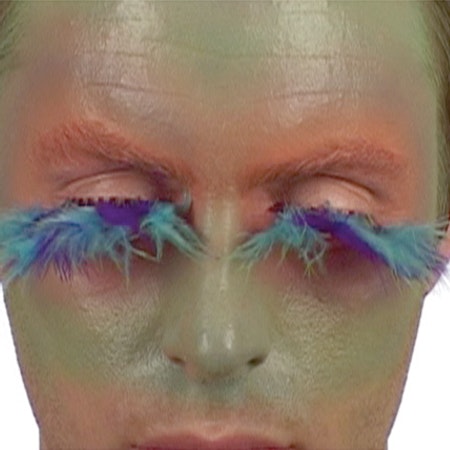
For Consandine seems drawn to these dangerous, erogenous zones of our imagination, achieved through heightened (although ambiguous) moments of theatre. The ‘wilful suspension of disbelief’ required in this is made explicit: a log appears to levitate before our eyes - until we recognise the slumberous grace of its arc, indicating a point of suspension. Illusion is then interrupted by artifice (as with the gradual recognition of the glutinous quality of heavy mascara); but this engineering is also itself fabulous. Why is the table supported against the wall when one leg is so emphatic? Does the beam of the tree relate to the structure of the gallery, such as the vertical column with which it seems to interact? Function as much as fiction is interrupted: mechanics broken, dismembered from purpose, to be instead dispersed in works of latent tumescence.
Linda Nochlin points out in her seminal text ‘Women, Art, and Power’ (1988): ‘The image of the cut-off leg offers an easily grasped, non-transferable synecdoche of sexual power relations…[and, in regard to a 1939 photograph by Andre Kertesz of a ballerina’s legs] it inevitably refers to the implied sexual attractiveness of the invisible model, presented as a passive object[vi]’. With Duchamp again brought to mind (specifically ‘Etant donnés…’), the potential of this displaced and unrequited ‘gaze’ is also found in Blanchot’s essay ‘The Gaze of Orpheus’[vii]. Orpheus is allowed to lead Persephone out of the underworld in which she is captive, on condition that he does not look back. At the last moment, Orpheus cannot resist, and this ‘illegal’ look causes Persephone to slip from his grasp. Blanchot posits this desiring gaze that fails, as the condition of art making.
Perhaps this thickened, mute figure of the desired other is also the absent Other of Consandine’s practice. For beyond the make-up and glam Consandine’s subjects are finally remote and inaccessible. To borrow again from Kertesz and another of his photographs, Satiric Dancer (1926): ‘Decorum is untrussed, as all four limbs are skewed in contrapuntal directions. There is no simple availability here: the codes of recumbency are electrified by over-action[viii]’. Consandine similarly cuts loose.
[i] Gian Lorenzo Bernini, Apollo and Daphne, 1622-25, marble; collection of the Galleria Borghese, Rome.
[ii] Ugo Rondinone, Art Now Vol. 2, ed. Uta Grosenick, Taschen, London, 2005 p.450.
[iii] This romanticised, commodified and ambivalent notion of the Other is, as Homi Bhaba points out ‘one of the most significant discursive and psychical strategies of discriminatory power’. See: Homi K. Bhaba, ‘The Other Question: The Stereotype and Colonial Discourse’, from The Sexual Subject: A Screen Reader in Sexuality, London & New York, 1992.
[iv] The word ‘panic’ derives from the Greek panikon meaning ‘pertaining to Pan’. Pan was a mischievous, carnal wood-deity found in the mythology of Classical Antiquity. See: www.etymonline.com
[v] See: George Bataille, ‘Eroticism’, London & New York, Marion Boyars, 1962 (1957).
[vi] Linda Nochlin, ‘Women, Art, and Power’ from Visual Theory, eds. Norman Bryson, Michael Ann Holly & Keith Moxley, Polity Press, Cambridge, 1991, p.25.. Nochlin is adamant that reversing the gender of the figure (as Consandine does) results in the legs instead being ‘signifiers of energy and power[vi]’: but this assumes a male viewer. In the same volume, Ludmilla Jordanova is critical of Nochlin’s use of the term ‘women’ and suggests instead ‘gender’, as masculinity is itself an equally contested notion in her view.
[vii] See: Maurice Blanchot, ‘The Gaze of Orpheus’ in The Space of Literature, trans. Ann Smock, University of Nebraska Press, 1982 (1955).
[viii] John C. Welchman, ‘New Bodies: The Medical Venus and the Techno-grotesque’ from Art after Appropriation: Essays on Art in the 1990s, G+B Arts International, Singapore, 2001 p.117.