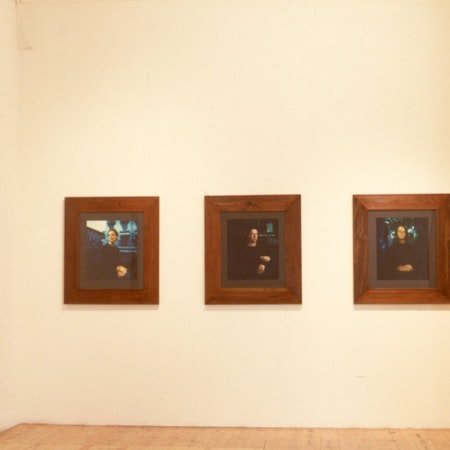
"The obscure object of desire" - Bunuel
The ear we have learnt, cannot be shut.
But the eye can.
The voice is always with us, even when we don't want to hear.
This is precisely the path that thoughts follow.
Sometimes what we apprehend is the effect of the voice
rather than the uttered words; one effect on us
could be guilt, another embarrassment and even shame;
though we are always ignorant of its cause.
The gaze, discontinuous as it is, follows the vicissitudes
of the voice, in the same fashion.
Plato showed us, in the Symposium, how the gaze
situated the agalmal [1] on the object,
thus making it a desirable object.
Sartre, in another kind of symposium, described
Hell as the gaze of others.
These opposites also encompass the voice.
Both the voice and the gaze can stretch,
accordingly, from a desirable object to a hellish one.
The exhibition which gathers us here,
offers the same compass
and reminds us that what we are seeing and hearing
is what we bring with us.
But that is not all.
Because if it is true that Shame on him who evil thinks? [2]
how can we avoid the fact
that to think evil is the partner of having thought good?
Honni soit qui mal ypense unites us here,
one may say, under the possibility
of shame, dishonour or even disgrace.
But if these are the possibilities, who can be
dishonoured, disgraced or shamed, if not someone
who once possessed honour, grace and probity?
This play of images, this repetition
of the subjects in different postures,
comes to tell usthat any posture is an imposture.
This posture/imposture is
the repetition of what Art is,
regardless of the means used.
Art, in fact, establishes a complicity
between what it offers and the audience.
Here are the eye and ear of the audience,
in complicity with images and words.
The complicity is no other than
images of posture/imposture and words of malediction
with which the author recognises that
whenever the eye is at play, there is only an evil eye. [3]
If we consider that, as in the agalma,
an act of perception is an act of desire
then we don't see or hear what is "out there"
but only what we desire.
It is from this metonymic function that
the so-called reality is erased.
The intention of the artist
is to perform a reality
which evokes indirectly the re-enactment of the moment
in which reality is erased.
To name the act of perception
is to re-introduce the subject to the scene
from where, since the beginning, Science has eradicated him.
It has long been known
that objectivity - the dream of Science -
is no more than shared subjectivity.
As Lacan pointed out, by re-doing and re-inventing,
Art repeats reality, making truth inhabit fiction.
This, as it turns out, means that so-called reality
is nothing other than the organisation of fantasy.
What we see, hear or feel
is the effect of a cause unknown to us.
Psychoanalysis denominates this cause: desire.
In the beginning was desire.
Oscar Zentner* Melbourne May 1988
1. AGALMA (cl. Greek) =image/aura.
2. Translation of exhibition title (from Medieval French).
3. INVIDIA = envy, from Latin root oidere = to see.